Mastering Visual Communication with the Error Glyph Icon
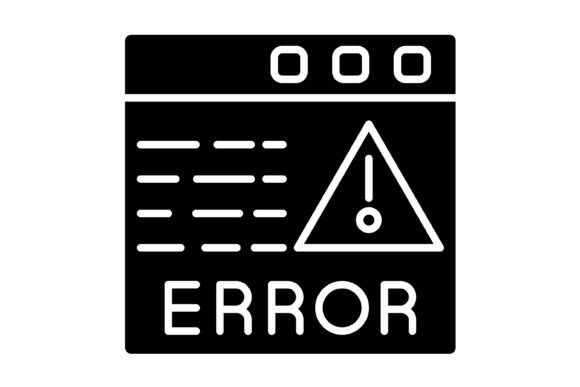
In the fast-paced world of digital interaction, clarity is currency. Whether you are a developer building a mobile app, a marketer designing a landing page, or a small business owner creating presentation materials, how you handle errors defines the user experience. A vague warning creates frustration, but a well-designed visual cue provides instant clarity. This is precisely where the Error Glyph Icon becomes an indispensable asset in your toolkit. It is not just a picture of a warning; it is a universal symbol designed to bridge language barriers and technical confusion, guiding users smoothly through the inevitable hiccups of software and design.
The Anatomy of a Universal Symbol
When you look at the Error Glyph Icon, you see a perfect balance of form and function. Visually, it typically adheres to the principles of modern typography and icon design—clean lines, balanced negative space, and immediate legibility. It carries a personality that is authoritative yet helpful. It doesn't scream "you messed up" in a chaotic way; rather, it says, "hold on, something needs your attention here." The style is versatile enough to fit into a flat design aesthetic or a slightly more dimensional interface without looking dated. Its appeal lies in its 100% vector nature, meaning it scales from a tiny favicon in a browser tab to a massive print banner without losing a pixel of sharpness.
Unlike a complex serif font or an intricate handwritten font, a glyph icon relies on simplicity. The visual characteristics are stripped down to the bare essentials so that the message is transmitted in milliseconds. This minimalism is its strength. It acts as a neutral design asset that supports your content rather than competing with it. Whether you are working on a sleek, dark-mode interface or a light, airy website design, the icon’s adaptability ensures it remains a cohesive part of your visual language.
Strategic Placement: Where the Error Glyph Shines
The utility of the Error Glyph Icon extends far beyond the 404 page of a website. Because the asset package includes AI, EPS, JPG, PNG, and SVG formats, you have the flexibility to deploy this visual across virtually any medium.
For web design and mobile apps, the SVG and Transparent PNG formats are critical. They load quickly and sit perfectly over complex backgrounds or textured surfaces. Imagine you are designing a dashboard for a small business owner; using this icon for form validation (e.g., a missing field) improves the usability of the tool instantly. In editorial design or packaging design, the EPS or AI files allow you to incorporate the symbol into technical manuals or safety instructions where printing at high resolution is non-negotiable.
Consider the needs of a content creator or blogger. You might be creating a tutorial video or a slide deck. Including the Error Glyph Icon in your presentation slides serves as a visual anchor, alerting your audience to "common mistakes" or "things to avoid." It functions as a premium font element does—setting the tone and guiding the viewer's eye. It is equally effective in social media graphics, where a quick visual warning can stop a user from scrolling and draw attention to a critical piece of information in a long caption or infographic.
Enhancing User Experience and Brand Perception
Typography and iconography are silent ambassadors for your brand identity. Using a high-quality asset like the Error Glyph Icon signals professionalism. It shows that you care about the details, even the details that occur when things go wrong. In the realm of UI/UX design, consistency is key. If your brand uses a specific style of sans serif font for its copy, you need iconography that matches that geometric precision. This icon provides that harmony.
From a psychological standpoint, a clear error icon reduces cognitive load. When a user encounters a problem, their stress levels rise. A familiar, well-designed glyph acts as a calming mechanism because it is recognizable. It maintains the visual hierarchy of your page; the error message stands out, but it doesn't break the aesthetic flow of your site. This consistency builds trust. A user is more likely to stay on a site that handles errors gracefully than one that throws up a jarring, mismatched warning sign.
Practical Application and File Flexibility
One of the standout features of this package is the diversity of file formats. As a designer or entrepreneur, you often work across different software environments. You might start a logo design concept in Illustrator, move to Canva for social media assets, and end up in Figma for web prototyping.
- AI and EPS Files: These are your master files. They are fully editable vector paths. If you need to change the stroke weight of the error icon to match a bold display font you are using, or if you need to adjust the color to match a specific Pantone swatch for print materials, these formats give you total control.
- SVG: The go-to for modern web development. It is lightweight and infinitely scalable, ensuring your website speed remains optimal while the icon looks crisp on Retina displays.
- PNG (Transparent): Perfect for drag-and-drop functionality. If you are a hobbyist or a small business owner using tools like PowerPoint or Google Slides, the transparent background allows the icon to float over any image or color block seamlessly.
- JPG: While less flexible for editing, the JPG format is useful for quick mockups or situations where file size is a concern and transparency is not required.
Integrating the Icon into Your Workflow
When selecting design assets, it is easy to get overwhelmed by options. However, the goal is always to solve a problem. The Error Glyph Icon solves the problem of ambiguity. It is a ready-to-use solution that requires no heavy lifting on your part.
If you are evaluating how this fits into your current project, consider the "squint test." If you squint at your layout, does the error state stand out? If not, this glyph is the solution. Furthermore, because it is designed for maximum usability, it pairs well with almost any typographic style. It won't clash with your script font headers or your modern typography body copy; it complements them by providing a standardized visual shorthand.
Ultimately, good design is about communication. The Error Glyph Icon